

By Phil Spalding
cambolc.co.uk, LinkedIn, BlueSky, Facebook
At the mid point of February AI has been a constant topic in the news. The frenzy is almost going viral like the early days of Social Media. The amount of money countries have said they will invest in AI has been eye watering. The US announced a $500 billion dollar fund led by OpenAI, Softbank, a soverign wealth fund and Oracle, called Stargate. The French government has announced an investment of Euro 109 billion. The UK government has announced it’s own plan for AI , the price tag for this so far is £14 billion. The figures so far do not include the ongoing funds already committed to AI. An Elon Musk led bid for Open AI was recently made in the region of $97.4 billion. With these figures rolling off the keyboards of news outlets it begs the question is AI really affordable for the average user or small business in the long term? It stands to reason you will want a return on that investment.
Working in the public sector as a supply teacher part of the time according to the UK governments AI action plan teachers will be one of the first to utilise AI for workflow tasks such as planning. A survey by Teacher Tapp ,carried out in support of the governments plan, indicated that 50% of teachers may be already using AI. The investment of £1 million (reported on the same government website as the survey) to develop tools for UK teachers to use pales in comparison to the figures mentioned above. The future workforce that will use the AI ie. the pupils will need training. Investment in IT literacy is also important.. The AI Utopia is not going to happen overnight or in the time frame some investors might want.
The anecdotal stories of a 30% of time being freed up for teachers may well be true but a lot of the AI tools are US centric at the moment and may not meet needs of UK teacher as regards curriculum content. As models receive more data this may change. Here is another problem: data security. The GDPR rules may make a lot of AI use for individual lesson planning using web based AI tools or even analysis of data mute. You might not be able to do it. Attempts to have a common global framework at the beginning of AI’s growth have been unsuccessful so far. The open, inclusive and ethical agreement did not meet the approval of the UK or the USA, albeit for slightly differing reasons. The solution may therefore be Sovereign AI.
Controlling the data that is used to train the AI models is where large companies offering a service will ultimately make their profit. OpenAI’s ChatGTP model may have a large set of data but it has until recently been frozen in time to September 2021. Functionality has been expanded to now allow it to search the internet for current information without a Human in the Loop (HITL). Checking becomes more important as writing the correct prompt becomes a skill that not all may adapt to. The more disinformation spread the less accurate your Large Language Model (LLM) might be to you. Having AI on company systems, especially those that are Microsoft based, often leads to lengthy approval processes. The phenomenon of employees smuggling in their favourite AI is now being recognised as a potential risk.
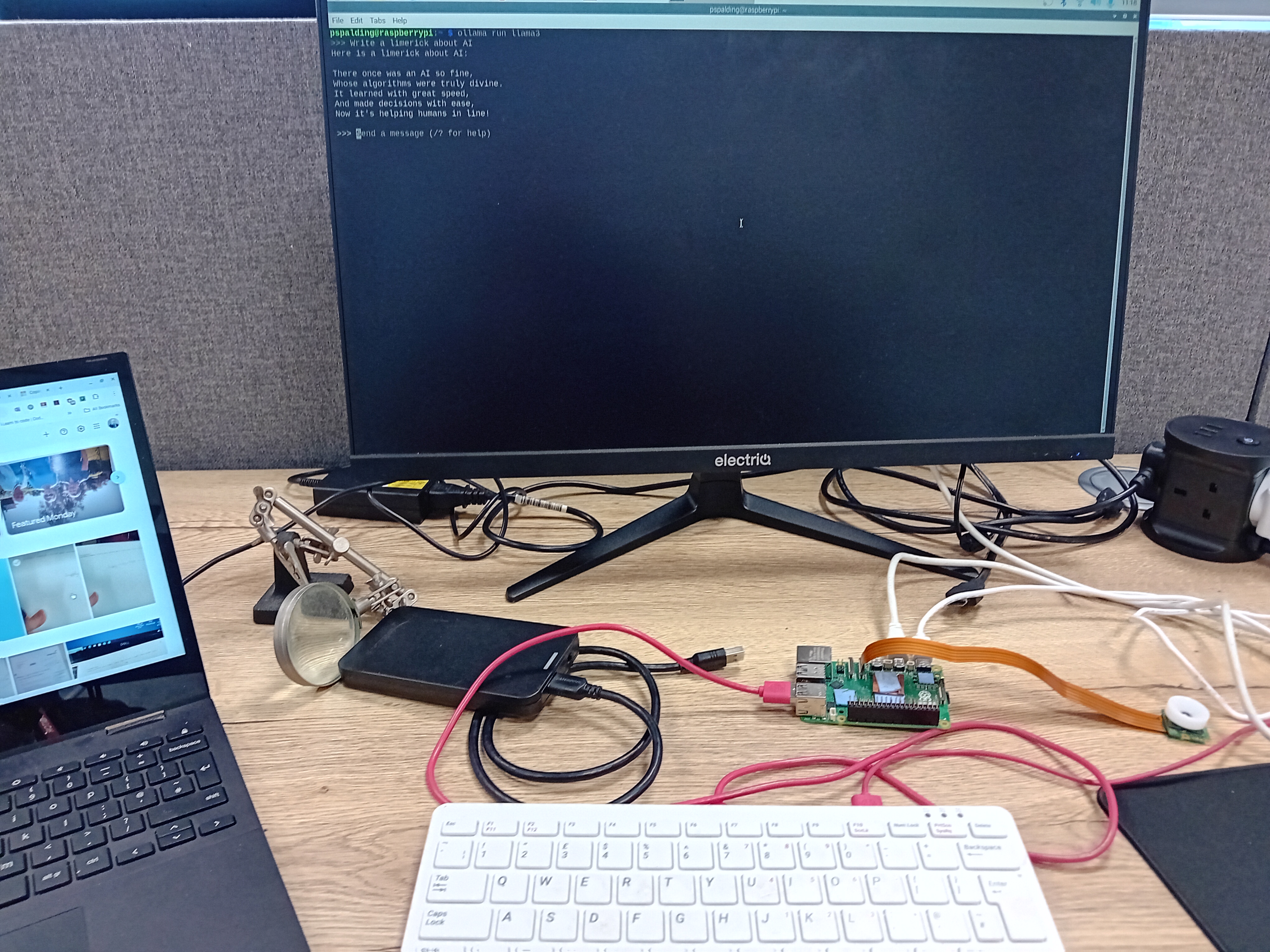
Running AI tools on your own data isolated from the influence of a net connection is one solution. The picture above shows a very capable Raspberry Pi 5 running Ollama using the model LLama3. This LLM is a the 7 billion data set (running on an 8GB Pi) was last updated last March. Although slow compared to webbased AI Chatbots it is in it’s own little world. Perfect for propriety use by companies who would rather not have their queries form part of the data set that everybody else is using. Running LLMs locally is becoming easier with the development of low cost devices such as the Raspberry Pi 5 and NVidia’s Jetson Nano. Plenty of job opportunities for a tech savvy helper to run this technology? Well, people make a living assembling other peoples flat pack furniture purchases. The technology is now getting cheap enough that we are starting to be in the realms of an IKEA type world for AI hardware where we all have the same homes and offices but with our own individual data flavour.
So what was on the screen of the Raspberry Pi 5’s using LLama 3 in the photo above?
The prompt was, “Write a limerick about AI”
The reply
There once was an AI so fine,
Whose algorithms were truly divine,
It learned with great speed,
And ,made decisions with ease,
Now it’s helping humans in line!
 Cambridge Online Learning Community